
Professional sheeters: what they are used for, how they work and how to choose between manual and automatic models
Professional sheeters are among the most widely used machines in pastry shops and bakeries, essential for professionals working every day with puff pastry, croissants and laminated dough.
A sheeter makes it possible to achieve uniform, repeatable thickness quickly and efficiently—a major advantage as production volumes increase.
In this article, we explain how professional dough sheeters work, the differences between Tekno Stamap manual and automatic models, and how to choose the right solution according to your production requirements.
What is a sheeter and how does it work?
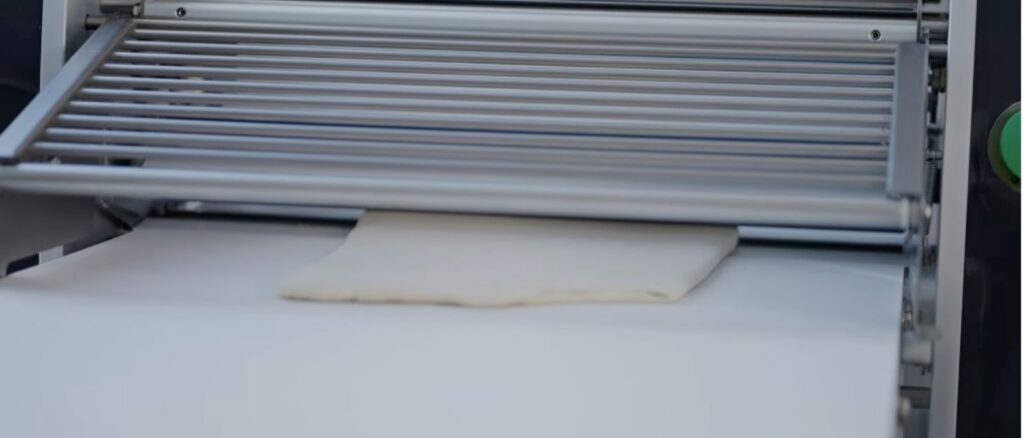
A sheeter is a machine designed to progressively reduce the initial thickness of dough in pastry production and bakery production, bringing it from its initial dimensions to the required thickness for subsequent processing.
The main components of the machine include:
- laminating rollers, which compress and reduce the thickness of the dough with each pass;
- the belt, which moves the dough back and forth beneath the rollers;
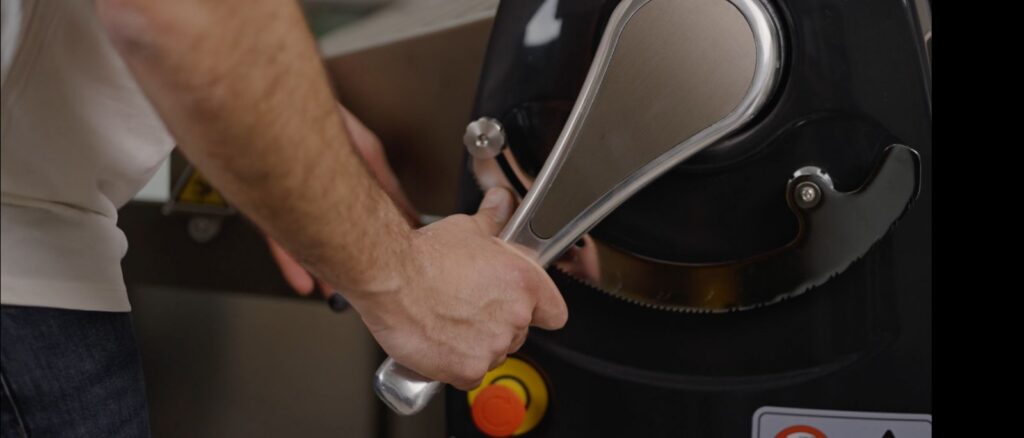
- thickness adjustment controls, which allow the roller opening to be set precisely and the same process to be repeated several times while maintaining consistent results.
The operation of a sheeter is straightforward: a motor drives the rollers and controls the back-and-forth movement of the belt.
The operator—or the program, in automatic models—progressively adjusts the roller opening until the thickness required by the recipe is achieved. Pass after pass, the dough is reduced evenly in thickness while maintaining its structure and elasticity.
Why is a high-quality sheeter important in a professional laboratory?
Sheeters can be used to produce a wide range of products, including laminated dough for croissants, puff pastry and shortcrust pastry, as well as many other pastry preparations and bakery products that require precise and repeatable lamination, including some particularly delicate doughs.
By maintaining a consistent dough thickness, a good dough sheeter contributes to proper proofing during the following stages. This also affects baking quality and the final result: properly laminated dough bakes more evenly.
Moreover, maintaining the same sheet thickness from one production batch to the next helps ensure consistent products over time.
Materials and design features that make daily cleaning easier
Tekno Stamap manual sheeters and automatic sheeters are manufactured using components suitable for food applications and feature scrapers that can be removed without specific tools, making daily cleaning and routine maintenance faster and easier.
The flour collection trays available on several models also help keep the work area tidy during operation, reducing the time required for cleaning and machine care at the end of a shift.
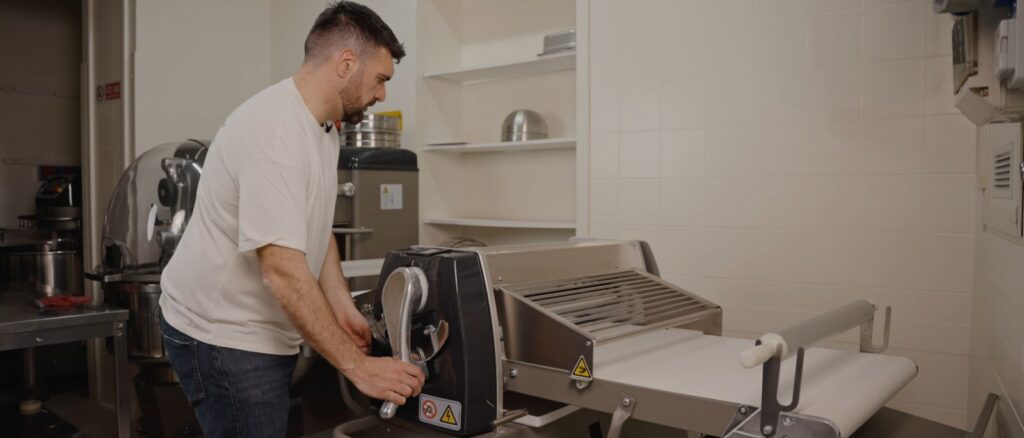
Manual vs automatic sheeters: differences and applications
The main difference between professional manual and automatic dough sheeters lies in the level of operator involvement required.
Features of professional manual sheeters
With a manual sheeter, the operator directly manages the dough as it passes through the rollers, adjusting the required thickness step by step according to the recipe.
This makes it particularly suitable for artisan laboratories with smaller production volumes and limited space, as well as professionals approaching dough lamination for the first time. It provides direct control over the process while requiring a lower initial investment.
Using automatic sheeters
An automatic sheeter, on the other hand, independently manages the entire lamination cycle according to previously set programs that can be repeated whenever required.
For this reason, it is ideal for environments with higher production volumes and processes requiring greater continuity. It reduces downtime, ensures consistent results from one cycle to the next and allows the operator to focus on other tasks during the longer stages of the lamination process.
One example of an automatic sheeter in high-volume production is the industrial or semi-industrial production of croissants. The automatic sheeter produces a dough sheet at the required width to directly feed croissant machines, such as our Croymat 3000–6000 and Croymat 10,000.
These machines then handle the cutting and rolling of the croissants, allowing the entire process prior to distribution of the finished product to be managed within a single production facility.
The process begins with the preparation of large quantities of dough using a suitable mixer, such as our larger-capacity fixed-bowl spiral mixers, including the Helix 160. This is followed by automatic sheeting, cutting and rolling, with the process ending in a blast chiller.
Tabel top manual sheeters: a compact solution for smaller laboratories
For businesses with limited space, table top sheeters offer a compact solution without compromising on precision or product quality.
The Tekno Stamap range includes the LAM 2 and EASY manual table top sheeters, designed to meet different requirements:
- EASY models are compact and foldable, allowing them to be stored at the end of the working day to free up counter space. They are designed for small laboratories and professional kitchens where space is limited.
- LAM 2 table top dough sheeters feature a more robust construction, greater customisation options and, in some versions, digital controls for setting and replicating the required dough thickness.
Automatic sheeters for more structured sroduction environments
Within the automatic range, SMART, Autosmart and Industrial Smart differ in terms of construction and features.
- SMART and Industrial Smart come with standard features including a touch-screen control panel, variable belt speed, Ø 84 mm laminating rollers, painted structure, dough collection trays and flour collection trays. Optional equipment available on request includes an automatic flour duster, automatic roller with “NO STRESS” system and cutting device.
- Autosmart, our most advanced model, comes as standard with an automatic flour duster, automatic roller with “NO STRESS” system, cutting device, touch-screen control panel, variable belt speed and Ø 84 mm laminating rollers. The AutoSmart also features a reinforced stainless-steel structure, 700 mm wide conveyor belts and dough recovery drawers.
The SMART and Autosmart dough sheeters are suitable for more structured artisan production environments.
Industrial Smart models, on the other hand, are designed to meet the production volume, timing and automation requirements of industrial processes, with fully automated cycles, optional automatic flour duster and roller, and up to 50 programmable lamination programs.
How to choose the right sheeter for your laboratory or production facility
As we always recommend, choosing the most suitable dough sheeter should be based on the working environment and the operational requirements of those who will use it:
- Production volume and frequency: continuous daily production requires different solutions compared with a laboratory working in small batches.
- Type of product: different laminated doughs may require different thicknesses and processing cycles.
- Available workspace: a bench-top or foldable model is often the most practical solution for smaller environments.
Another important factor is the desired level of automation. Professionals looking for direct control over the process may prefer a manual model, while automatic dough sheeters provide significant advantages in terms of time and consistency for businesses managing repeated production cycles.
Another aspect that should not be overlooked is ease of cleaning and maintenance. Removable components and stainless-steel surfaces help reduce downtime between production cycles while supporting proper hygiene standards.
Regardless of the model selected, investing in a high-performance professional machine built with materials suitable for food contact means achieving consistent, high-quality results over time.
These are the principles behind Tekno Stamap’s range of manual and automatic dough sheeters, designed to support both artisan laboratories and larger industrial production facilities.
Are you considering purchasing a professional sheeter? Contact us: we will help you identify the model best suited to your production requirements. You can also book a visit to our Stamap LAB to test our machines in person.